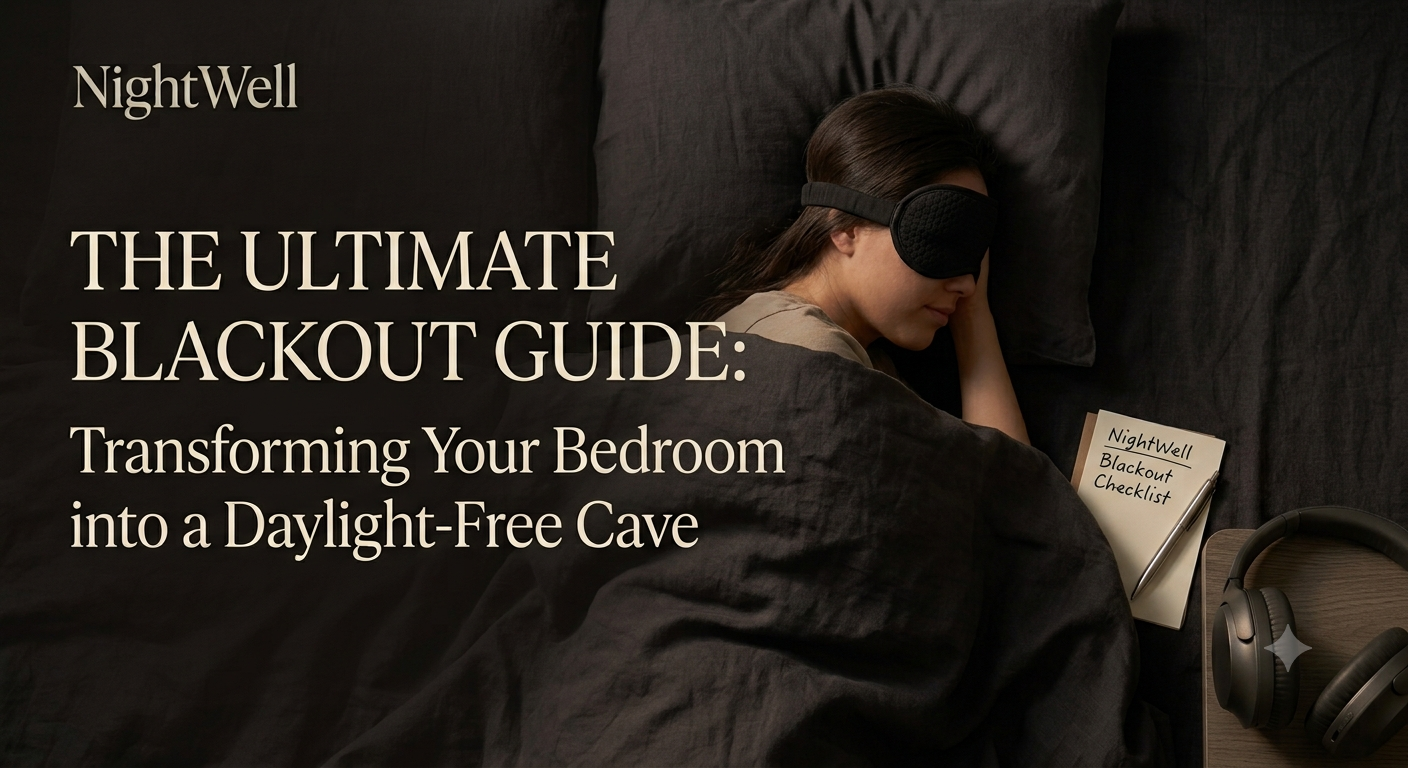
The Ultimate Blackout Guide: Transforming Your Bedroom into a Daylight-Free Cave
A thin line of light around my curtains was enough to keep my brain half-alert every single morning. Here's the exact, step-by-step way I got my bedroom to true 100% blackout."
The first blackout curtains I ever bought were a disaster. I saw "blackout" on the label, hung them up, and figured I was done. Then I laid down that first morning after a shift and watched a thin line of daylight creep in around every single edge of the window frame — top, sides, bottom. It was faint, but it was enough. My brain clocked it immediately, and even though I was exhausted, some part of me stayed just alert enough to know it was daytime outside.
That's the thing nobody tells new night shifters: light doesn't need to be bright to wreck your sleep. Even a small amount hitting your eyes tells your brain to suppress melatonin and start winding down its sleep signals, because as far as your biology is concerned, daylight means "be awake." A few slivers of light around a curtain frame is enough to keep part of your brain half-alert the entire time you're trying to get real rest. If you actually want to sleep during the day the way your body sleeps at night, the goal isn't "mostly dark." It's 100% dark, edge to edge.
Here's exactly how I got there, step by step.
Step 1: Get Curtains That Actually Extend Past the Window
This was my first mistake — buying curtains sized to just barely cover the glass. Light doesn't care about the glass, it cares about gaps. Your curtains need to extend several inches past the window frame on every side (top, bottom, and both sides), and the curtain rod should be mounted wide enough and high enough that there's no direct light path around the edges. If you can see any sliver of window frame poking out from behind the curtain when it's closed, that's a gap light will find.
Step 2: Close the Gaps Blackout Curtains Alone Can't Fix
Even well-fitted curtains still let light bleed through wherever fabric meets wall. A few fixes that made a real difference for me:
Velcro or magnetic strips along the curtain edges, sticking the fabric to the wall or window frame so there's no gap for light to sneak through, even on windy days when curtains shift.
A blackout curtain liner behind your regular curtains if you want them to look nicer from the street but still function as a true light block.
Foam board or blackout film cut to fit the window underneath the curtains, for a completely light-proof layer if your windows get particularly strong morning sun.
Step 3: Deal With the Door
I didn't think about my bedroom door as a light source until I noticed a strip of hallway light glowing under it every morning. If anyone else in your house is up during the day — kids, a partner, roommates — that light under the door adds up.
A draft stopper or rolled towel along the bottom of the door blocks that strip of light completely.
If you want a more permanent fix, a door sweep (a cheap hardware store install) does the same job without you having to remember to place a towel every morning.
Step 4: Handle Any Light-Emitting Devices in the Room
This one surprised me. After I'd fully blacked out the windows and door, I was still catching small flickers of light from a phone charger LED and a smoke detector indicator light across the room. In a truly dark room, even a tiny point of light is noticeable and can be enough to keep your brain from fully settling.
Cover small indicator lights with a piece of electrical tape (never cover a smoke detector's sensor itself, just the indicator light if it's separate — check your device first).
Charge your phone screen-down or across the room, not glowing next to your pillow.
Step 5: Use a Sleep Mask as Your Backup, Not Your Only Line of Defense
I used to think a sleep mask alone would solve everything, and treated my curtains as optional. It's actually the opposite — a mask should be your backup for the mornings when even a perfectly blacked-out room isn't quite enough (an unusually bright day, a hotel room while traveling, whatever). Fix the room first. Let the mask be insurance, not your whole strategy.
What Full Blackout Actually Changed for Me
Once I closed every gap — curtains extending past the frame, the door sealed, even the tiny device lights covered — the difference in how deeply I slept was immediate. I wasn't half-alert anymore. My body finally got the same kind of uninterrupted dark that it would get sleeping at night, and my sleep started actually feeling like rest instead of a nap I was fighting the whole time to hold onto.
If you're new to night shift and only do one thing from this guide, do the curtains right — the extension past the frame and sealing the edges made the single biggest difference for me. Everything else is what closes the last few gaps once you've got that foundation in place.
Want your whole sleep environment and schedule mapped out around your actual shift times? I built a free Schedule Builder on NightWell to help you plan your sleep, meals, and routine together.
Join the NightWell Newsletter
Night shift tips, healthy recipes, sleep advice, meal plans, and weekly wellness delivered to your inbox.
Comments
Be the first to comment.
Sign in to leave a comment.